
- July 21, 2026
- by: Public Kitchen Team
- No Comments
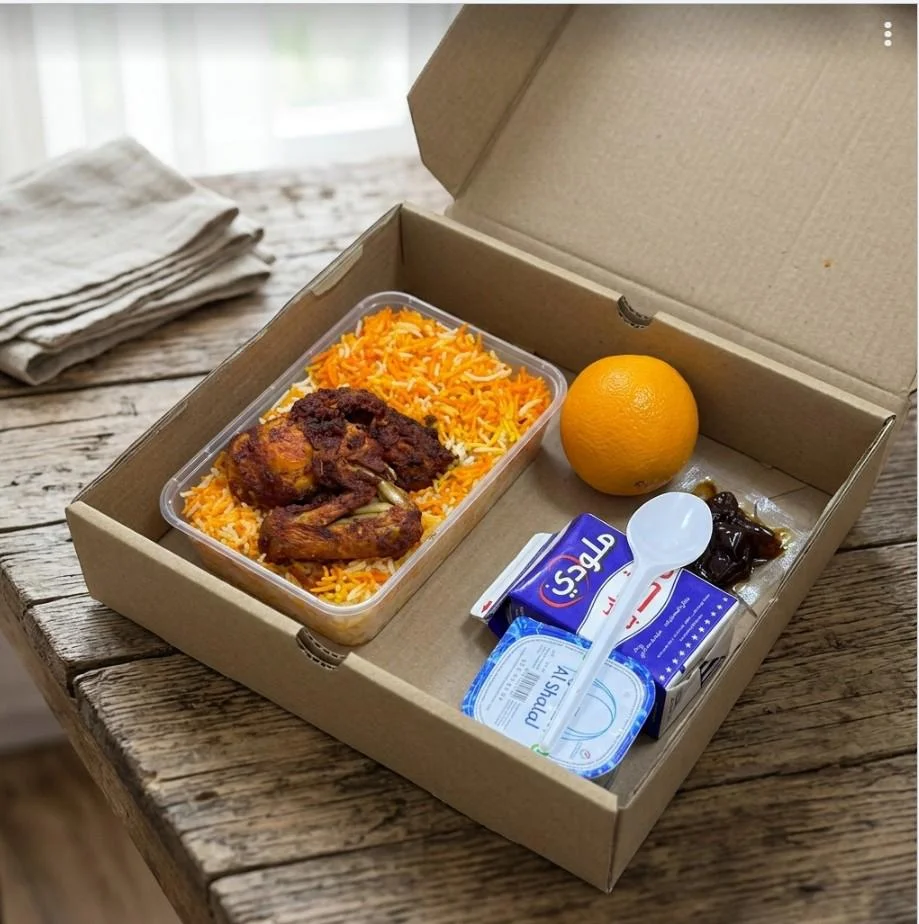
Feeding 500 construction workers on a fixed daily schedule is a fundamentally different operation than cooking a family dinner. The gap between those two things, logistics, food safety, portion consistency, packaging durability, and delivery timing, is exactly where a lot of well-intentioned feeding programs run into trouble. Ready-to-serve meal boxes for charity in the UAE close that gap by removing on-site cooking from the equation entirely, leaving organizations free to focus on reaching people rather than running a temporary kitchen.
Pre-packaged, complete meals delivered directly to a distribution point require no on-site preparation, no dedicated kitchen staff, and no cooking equipment at the venue. That makes them practical for a wide range of settings: labor camps, construction sites, mosque feeding programs, community charity drives, and large-scale Ramadan Iftar distribution across Dubai.
Why Bulk Food Distribution Demands a Different System Entirely
Most organizations underestimate how much the logistics change once feeding numbers cross a certain threshold. Cooking for 50 people is manageable with a small team and basic equipment. Cooking for 300 people consistently, on time, every day, at a location without a proper kitchen, that’s a different category of problem.
Bulk food distribution solutions need to account for three things that individual meal service doesn’t: portion consistency across every single box (because inconsistency at scale creates visible inequity), food safety across longer transport windows, and packaging that survives handling by volunteers who may be rotating in from different community groups each week. A ready-to-serve system addresses all three before the boxes ever leave the preparation facility.
Feeding Labor Camps and Construction Sites: What Consistent Delivery Actually Requires
Labor camps and active construction sites in Dubai often need to feed several hundred workers on a schedule that doesn’t flex much. Meal service at these locations has to work around shift patterns, outdoor or semi-outdoor distribution environments, and the practical reality that most sites don’t have dedicated dining infrastructure.
Packaged meals that work in this context share a few specific characteristics. They arrive in quantities that match the worker headcount, at times that align with shift breaks rather than general delivery windows. Packaging holds up to being stacked, transported in bulk, and handed out quickly without falling apart. Nutritional consistency matters too, workers doing physically demanding labor in Dubai’s heat need meals with adequate calorie and protein content, not just volume.
Some labor camps need daily delivery throughout a long project cycle. Others need occasional bulk support during specific phases when headcount is highest. A delivery arrangement that can handle both patterns – recurring daily orders and occasional one-time bulk orders – suits the actual variability of construction site feeding far better than a fixed-volume contract that assumes consistent headcount.
Mosque and Community Feeding Programs: Planning for Predictable Peaks
Mosques and community organizations across Dubai run feeding programs that fluctuate significantly by time of year. Daily Masjid feeding programs often run at a consistent moderate volume throughout the year, then scale up sharply during Ramadan when Iftar distribution becomes a central community activity.
That seasonal spike is the part that catches organizations off guard. A mosque that feeds 150 people on a typical evening may need to serve 600 or more during Ramadan, with no time to ramp up kitchen operations and no infrastructure to support that kind of volume from scratch. Charity food supply solutions built around ready-to-serve boxes from Public Kitchen let the same distribution process handle both the normal-season volume and the Ramadan peak – the only variable is the order quantity.
| Program Type | Typical Volume Pattern | Key Planning Consideration |
| Daily Masjid feeding | Consistent year-round | Reliable recurring schedule |
| Ramadan Iftar distribution | Sharp seasonal spike | Advance booking weeks ahead |
| One-time charity drives | Variable, event-specific | Flexible one-time bulk ordering |
| Labor camp / construction site | Recurring with headcount shifts | Adjustable recurring arrangement |
Distribution Across Dubai: Why Location Planning Is Part of the Logistics
Dubai’s geography and traffic patterns affect meal delivery more than organizations typically account for in their initial planning. A distribution point in Al Barsha operates under different access conditions than one in Dubai Silicon Oasis or Nad Al Sheba – and the difference in delivery timing, route planning, and coordination with site access points can affect whether a 7 AM shift meal actually arrives at 7 AM or 7:45 AM.
Charities and organizations running feeding programs across multiple neighborhoods benefit from coordinating delivery schedules that account for each location’s specific access points and traffic windows.
Al Nahda and International City, for example, sit in corridors that see significant morning congestion from workers commuting to industrial and logistics zones – a food delivery scheduled for 8 AM in those areas needs buffer time built in that wouldn’t be needed for a site in a quieter residential pocket.
Getting that coordination right once means the distribution runs smoothly every week without constant follow-up.
Planning Checklist: Before You Place a Bulk Meal Order for a Charity or Camp
Working through a few practical questions before placing a bulk food order prevents the most common distribution problems:
-
- Estimate the number of people being served per distribution event, with a realistic buffer for turnout variation of at least 10 to 15 percent above the expected figure
-
- Decide whether the arrangement should be a one-time order, a weekly recurring schedule, or a monthly bulk delivery – and confirm the provider can accommodate whichever structure fits
-
- Check that delivery timing aligns with the distribution window at the site, accounting for location-specific access and traffic conditions
-
- Plan for seasonal volume changes – Ramadan Iftar distribution typically needs to be confirmed several weeks in advance to guarantee availability during peak demand
-
- Confirm whether distribution will happen indoors or outdoors, since packaging requirements differ between a controlled indoor environment and an open construction site in summer heat
FAQ
How far in advance should bulk meal boxes be ordered for a charity event?
For standard one-time events, most providers need at least 3 to 5 days of lead time to confirm quantities and schedule delivery. Larger distributions, anything above 300 boxes, benefit from a week or more of advance notice. Ramadan Iftar programs are a specific case: demand across Dubai increases sharply from the first week of Ramadan, and organizations that secure their arrangements 3 to 4 weeks before the month begins consistently report fewer supply issues during peak weeks.
Can meal box quantities be adjusted if turnout is higher or lower than expected?
Most providers can adjust quantities for recurring orders with 24 to 48 hours of notice, depending on preparation timelines and existing commitments. Same-day adjustments are harder to accommodate reliably, which is why building a 10 to 15 percent buffer into the original order quantity is standard practice for community programs where attendance isn’t guaranteed. For labor camp feeding with a fixed headcount, adjustments tend to be more predictable.
Are ready-to-serve meal boxes suitable for outdoor distribution at construction sites?
Packaging designed for bulk distribution in outdoor settings is specifically built to handle stacking, transport, and handling in non-climate-controlled environments. For Dubai’s summer conditions – where outdoor temperatures regularly exceed 42°C during peak hours – distribution timing matters alongside packaging quality. Morning delivery before 9 AM or evening distribution after 6 PM reduces the food safety window that extreme midday heat creates, regardless of packaging standard.
What’s the difference between a one-time bulk order and a recurring arrangement?
A one-time order suits a specific event, such as a charity drive, a community gathering, or a single-site feeding day, with no commitment beyond that order. A recurring arrangement sets a fixed schedule (weekly, twice-weekly, or monthly) for the same or similar quantities, which typically allows better delivery consistency and sometimes better unit pricing for high volumes. Labor camps running a 6-month construction cycle almost always benefit from a recurring structure rather than reordering manually each week.
Do meal box providers scale up for Ramadan Iftar distribution specifically?
Meal providers experienced in community feeding in Dubai typically plan for Ramadan demand as a separate operational period, because the volume increase across mosques and charity organizations is predictable and significant. Some providers report a 3 to 5 times increase in daily orders during the final two weeks of Ramadan compared to off-season volumes. Organizations that confirm Ramadan arrangements in advance, rather than placing orders week by week, are far less likely to face availability constraints during that period.
Can a single arrangement cover delivery to multiple distribution points across Dubai?
Coordinating delivery to multiple locations under a single order arrangement is possible with providers who handle multi-point delivery logistics. A charity running Iftar distribution in both Deira and International City on the same evening, for example, needs delivery timed to both sites’ distribution windows – which requires route and timing coordination rather than just splitting a single order. Confirming that capability with the provider before finalizing any multi-location arrangement avoids last-minute logistics problems.
What packaging features matter most for labor camp meal distribution?
Packaging for labor camp distribution needs to handle three practical stresses: stacking in bulk during transport, outdoor or semi-outdoor handling by volunteers or distribution staff, and retention of food temperature between delivery and consumption. Compartmentalized packaging that keeps dry and wet food components separate holds up better during transport than single-container formats. For sites where workers eat at staggered times, packaging that maintains adequate food temperature for 45 to 60 minutes after delivery is a meaningful practical consideration.
How should organizations account for dietary requirements in bulk meal box orders?
Large feeding programs serving labor camp populations in Dubai often include workers from South Asian, Southeast Asian, and East African countries with varying dietary norms. Vegetarian options matter for a meaningful subset of workers, typically 15 to 30 percent depending on the workforce composition, and confirming whether a provider can supply a set proportion of vegetarian meal boxes alongside the standard order prevents the common problem of running out of suitable meals for part of the group.
Is it more cost-effective to order ready-to-serve meal boxes or organize on-site cooking for large groups?
On-site cooking appears cheaper per meal at a surface level but carries costs that rarely appear in initial estimates: kitchen equipment rental or transport, dedicated cooking staff, food safety compliance at temporary cooking setups, fuel or gas supply, and the time cost of coordinating all of it. For groups above roughly 100 people, the total cost of on-site cooking typically exceeds ready-to-serve meal boxes when all those inputs are included and the operational complexity difference is significant regardless of cost.
What information does a provider need to confirm a bulk meal order for a labor camp or charity event?
A meal provider typically needs five things to confirm a bulk order: the distribution date and time, the location and any site access requirements, the number of meals, whether the arrangement is one-time or recurring, and any specific dietary requirements for the group. For first-time orders, some providers also ask about the distribution setup whether there are volunteers on-site, whether boxes need to be stacked in a specific format for quick handout, and whether the site has vehicle access for a delivery truck of a given size.
Order Now